Author: Rick

  • The Need

    The Need

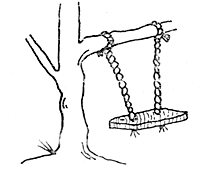
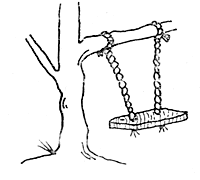
    Here’s an example of what can go wrong with even simple development projects that embark on work without agreeing a process:

    • What the user asked for– users and business specialists may find it difficult to convey requirements without getting tied up in design detail. And they are often not very good designers and may have a preoccupation with cost.
    • How the analyst saw it– some analysis believe in the concept of perfect technology. It’s a powerful concept, as design does not feature in their models. But reality effects requirements as the test team will tell you.
    • How the system was designed– designers love design. Too much design and it never gets built, too little design and it only works once.
    • As the dev team built it– it’s ok, we’ll refactor it later. We just need some more wood…
    • What was really wanted– it seems so obvious, why didn’t the users say so at the review?
    • How it actually worked– it’s taken up all the resources so the team had to hire in more. The next patch will fix it, honest.

    Good, simple communication can solve many of the development problems faced by IT projects. Together with an effective process the documentation, meetings and activities reduce the chances to these mistakes.

    To find out more please contact our consultants to discuss your requirements in more detail.

  • Web site released for local business Home Chic Home

    May 2011: Objecta design web site for retail business HomeChic Home specialising in fasionable shabby chic furniture and accessories. A blog is planned for 2012 to showcase their range of products.

  • Contract with UBS extended

    April 2011: Objecta extends contract to provide business systems analysis skills for UBS Investment Bank. Applications include independent price verification for a range of financial instruments along with reference data feed processing.

  • UBS added to client list with new business contract

    September 2010: Objecta wins contract to provide business systems analysis skills for UBS Investment Bank. Our chief consultant will provide a mix of agile analysis techniques to a range of high volume data processing for their back office general ledger application suite.

  • Calligraphy web site designed for Ann Bowen

    April 2010: Objecta develop complete web site solution for UK calligrapher Ann Bowen. Work includes web site design along with digital image creation and metadata for her extensive showcase.

  • Business won with CMA-Vision

    March 2010: Objecta wins contract with CMA Vision (part of CME) to provide business systems analysis to reengineer their 4th generation Quote Vision application.

  • Another public sector contract secured

    September 2009 – Objecta win contract with Office for National Statistics to provide system analysis skills in digital content management.

  • Contract with BP continues for 3rd major release

    January 2008 – Objecta extend contract with BP to add test analysts for BP Shipping’s global marine assurance clearing project. Agile testing focuses on system, UAT & release processes together with test scenario planning.

  • Contract with BP extended

    July 2007 – Objecta extend contract with BP to supply business analysis consultancy for BP Shipping’s global marine assurance clearing project. Staff lead analysis of web-service based inspection reviews.

  • Agile analysts – do they exist?

    I like to think I’m agile. Most of the time I’m working as an analyst on projects, split between business and system analysis tasks. I talk with the business experts and help them define their requirements from requests to change or add new behaviour to adapt to business needs. In an ideal agile world I’d be redundant, as the business would have resource to allocate experts to work alongside developers in the project team. Fortunately for me and many other analysts the business are rarely flushed with enough experienced business experts and must rely on a go between to convey their message. I like to think I add value by removing any preconceived notions the business may have in specifying how they want the new functionality to work, by filtering their requirements and extracting what they want it to do. I might write a story that details a change to an operational report or define a new addition to the product set. I seek estimates from the developers and feed this back to the business for approval. As a go-between, I’m fulfilling a legitimate agile role.

    But is there really a need for an agile analyst? Is the term an oxymoron? It’s a question often asked by companies starting out on the agile path. CEOs read agile books about empowerment and business sponsors and plough in with pilot projects that bring swift results. They attend seminars and see the productivity of pair programming. Six months or so after the heady kick-off meeting and countless show and tell sessions the business realise they have more work to do than automation can bring. Who’s going to handle the customer support lines? Who will send the white mail and respond to written enquiries? Just what does Sox mean to audit? Soon the full time business sponsor is part time or has little or no time to spare at all. We’ve seen it happen on several projects.

    Beyond the consultant’s vocabulary of business process change and IT infrastructure lays the reality of an end-to-end process. In the haste to embrace agility the business may forget this. But I like to think the analyst never will. The agile analyst can fill the gap when the initial sponsor retreats or play the role of surrogate business expert when full time secondment was never an option. They may even re-badge themselves as product specialists.

    I like to think the agile analyst brings a few more tools and techniques that the businesses sponsor or developer could rarely provide. As an analyst I can create models and unambiguous diagrams that slay endless business arguments. For example, a state diagram that clarify exactly in which circumstances we will accept a certain business event. Or I can create a data model that captures the legitimate rules for relating product to service. It’s true, once these business requirements are understood by the developers my effort if no longer required, I’ve fulfilled my role. But when significant changes are required later on the analyst can again help filter and convey requirements without bias of technical forethought.