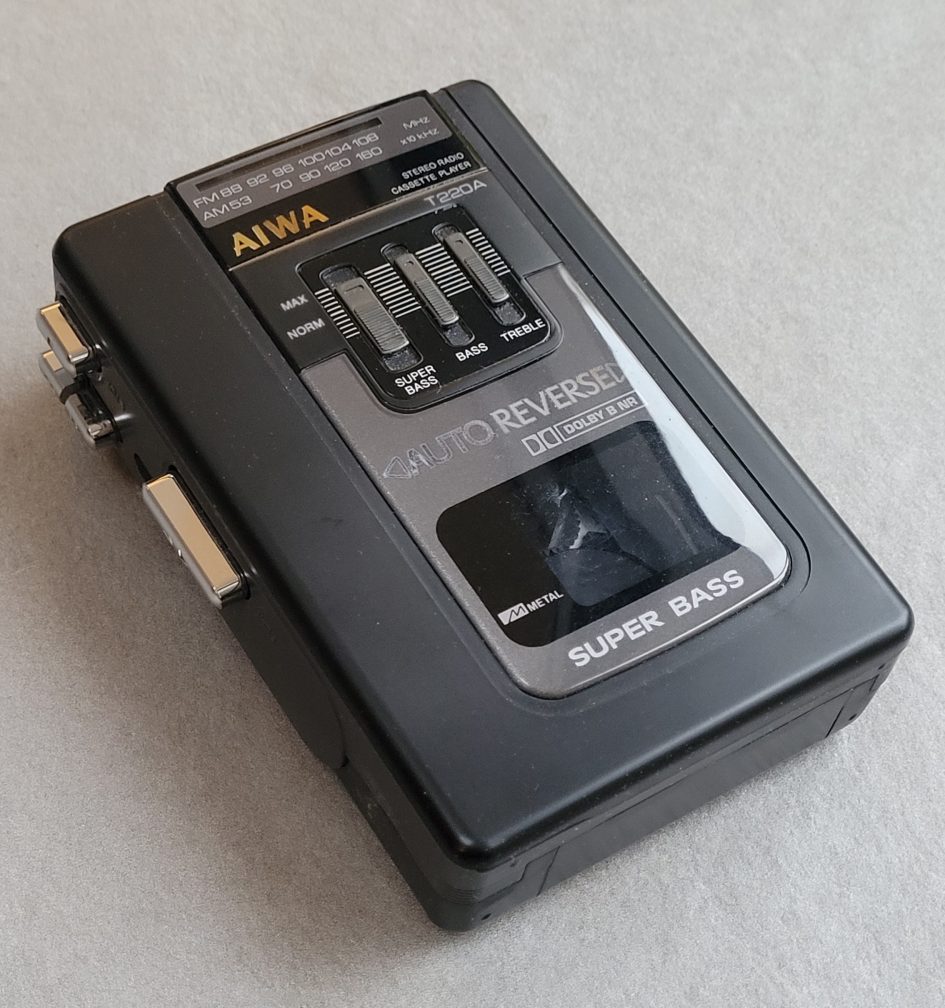
Do you have an Aiwa or other vintage cassette player from the 1990s that has lost its volume and no longer sounds super bass? Or maybe you can hear humming and ticking sounds when the motor runs between tracks? If so, I’ll run through some alternative ways to repair and fix the audio problems that can develop on these retro cassette players.
Low Audio Levels / Lack of Bass
My Aiwa HS-T220A, which features ‘Super Bass’ had lost volume on the right channel and lacked the bass frequencies these 1990 cassette players boast. The usual suspects for this type of fault are aging electrolytic capacitors — the bane of most retro technology from this era — along with oxidised jack sockets.
Access to the Aiwa’s internal circuit board is fairly easy after removing the 4 fixings using a small cross head driver. You will also need a small plastic pry tool like the one shown in the photo below. When using the pry tool, take care not to break the thin plastic clips that hold the rear case. Gently lift the rear free from the battery end to clear the volume thumbwheel. Don’t pull too hard as there’s a short thin black wire soldered directly to the circuit board. See photo below.
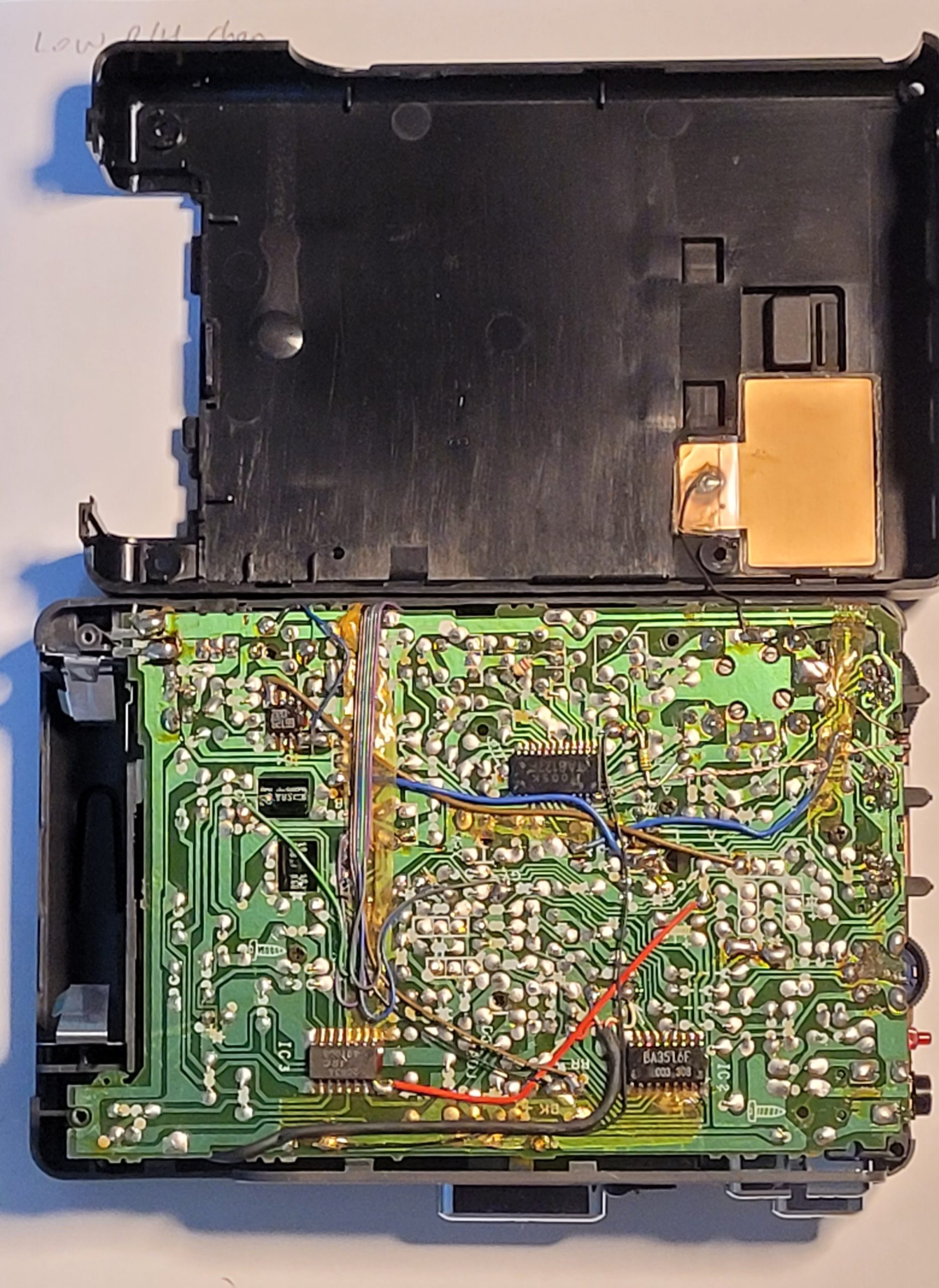
Inside the Aiwa T220A
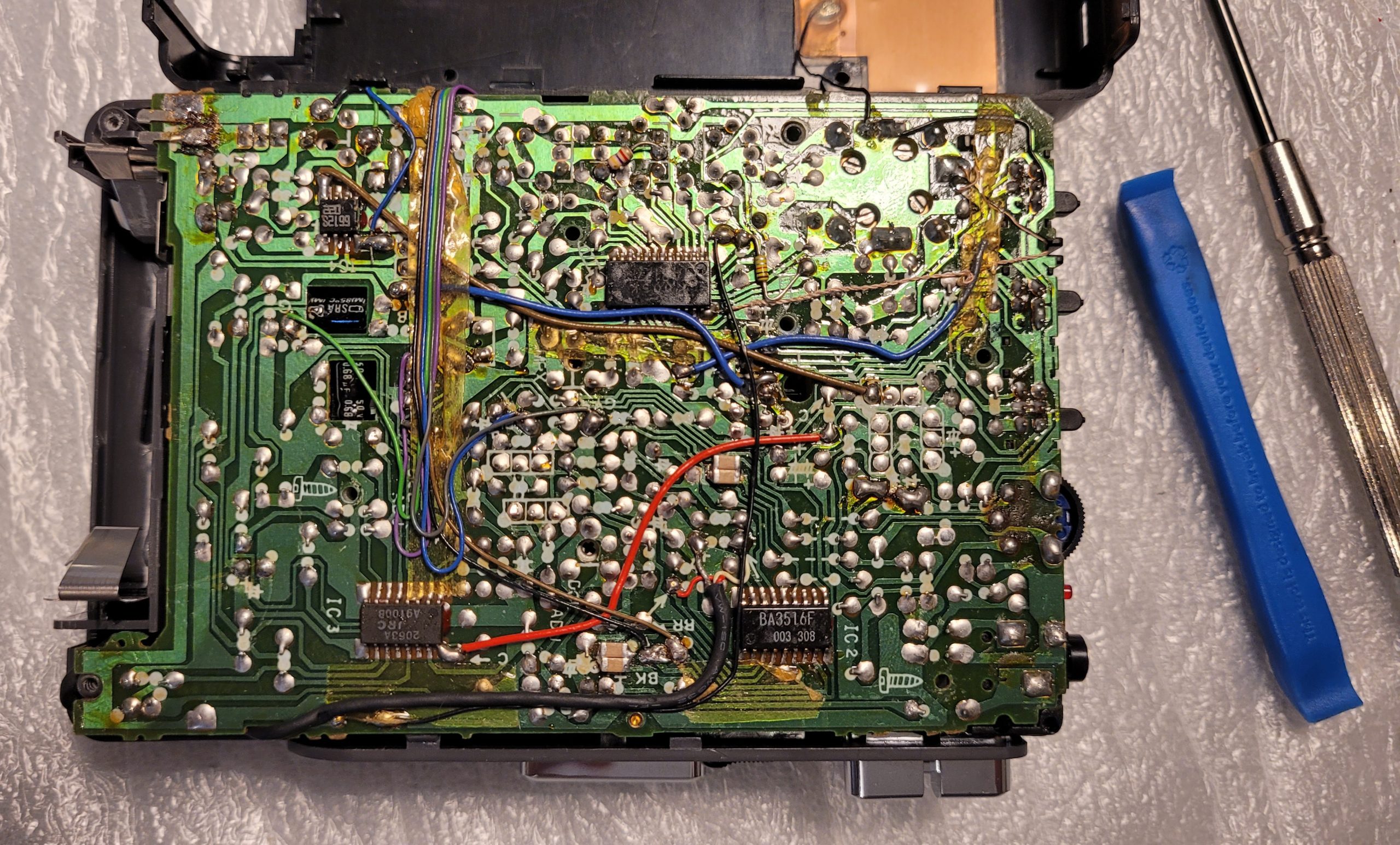
Aiwa T220A Circuit Board Tools
After checking the resistance of the jack socket contacts, which all measured a healthy 0.1Ω, I traced the right hand audio path back. The service manual is available for download from the excellent Hifi Engine website – see useful links below.
The BA3516F audio output chip uses a 220µF / 2v Nichicon electrolytic capacitor to drive each headphone channel. The component tester (see Component Tester Uses and Review) found C13 with a reading of 168uF, 9.4Ω and a VLoss of 25%! C14 was not much better at 262uF, 8.3Ω, 6.5%. Driving a 32Ω headphone via a near 10Ω resistance it was hardly surprising sound output was low!
With the fault traced to the 220µF / 2v 5x6mm Nichicon output capacitors I thought it would be easy to find a replacement. However with a micro size of 6x5mm (H x D) it proved impossible. I tried some 6v 8 x 7mm Multicomp caps but these were too large and jammed on the cassette belt and cogs that sit just below the PCB. A 2v DC working voltage is extremely low and must have been manufactured specially for compact audio devices.
So I decided to try a pair of 100µF SMD multilayer ceramic capacitors — see links below for details of the type used. Surface mount devices are soldered directly on the PCB so will not touch the cassette mechanics below. Wired in parallel, these almost measure the same capacitance as the Nichicon’s with a fraction of the series resistance at just 0.12Ω. And no need to worry about polarity or inserting them the right way around as the ceramic caps are not polarised.
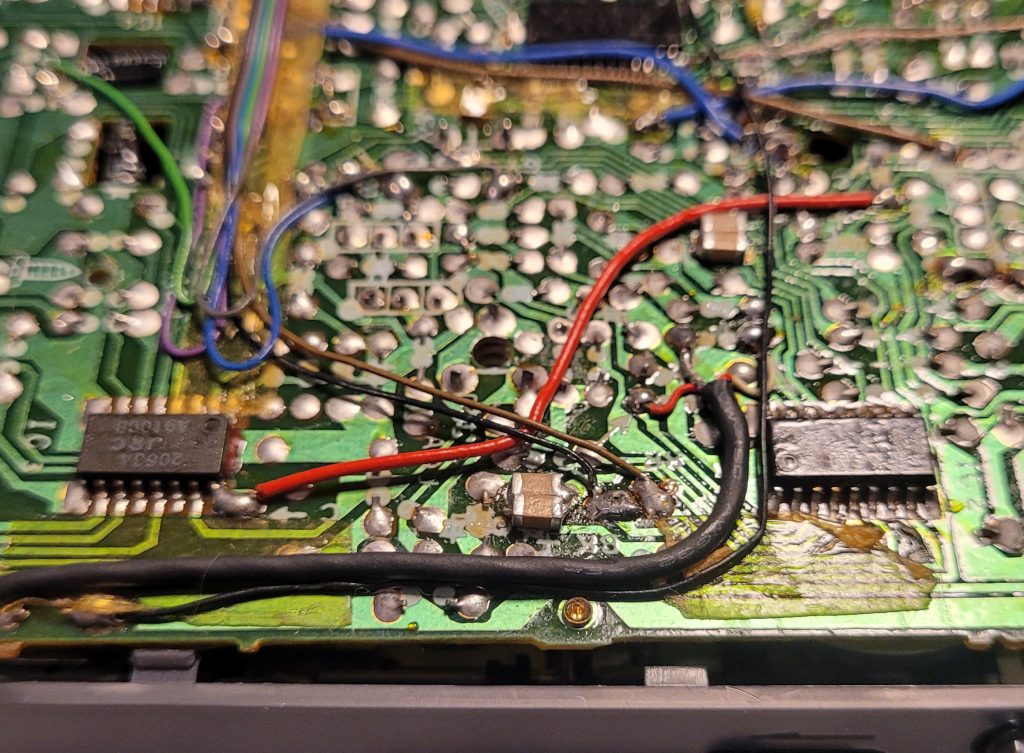
Pairs of multilayer SMD ceramic capacitors
With the new capacitors in place the sound levels for each channel were equal creating a nice stereo image rather than the thin distorted sounds I heard initially. “Super bass” also lived up to its promise albeit rather too loud on a decent pair of headphones. Yes, you will need to forget your Bluetooth beauties and rummage around for a wired pair with these 1990s wonders! Oh, how Apple (h)ate them!
Humming and Clicking
On careful listening I soon discovered another problem. On quiet passages I could hear humming and clicking from what sounded like the motor. But this was not mechanical noise, it was coming via the headphones. Audio was crystal clear on FM radio so the problem has to be electrical interference from the motor circuitry.
Looking at the circuit diagram I could see another pair of 220µF Nichicon electrolytics, C15 & C16 – this time 4v so a little larger. These provide the decoupling and smoothing from the 3v battery supply. The component tester confirmed C15 was faulty with readings of 116µF, ESR of 9.4R at Vloss of 42%! No wonder the motor noise was getting through.
I removed C15 and replaced with a 6v Multicomp electrolytic, which fitted without fowling the mechanics.
This solved the motor noise on playback but I could still hear a faint clicking and crackling from both channels on rewind. Scratching head I reached for the Tek oscilloscope to look for tell tale glitches on the 3v supply. I suspected C16 which had wires soldered above and little clearance below, so I soldered another 100uF ceramic across the existing capacitor.
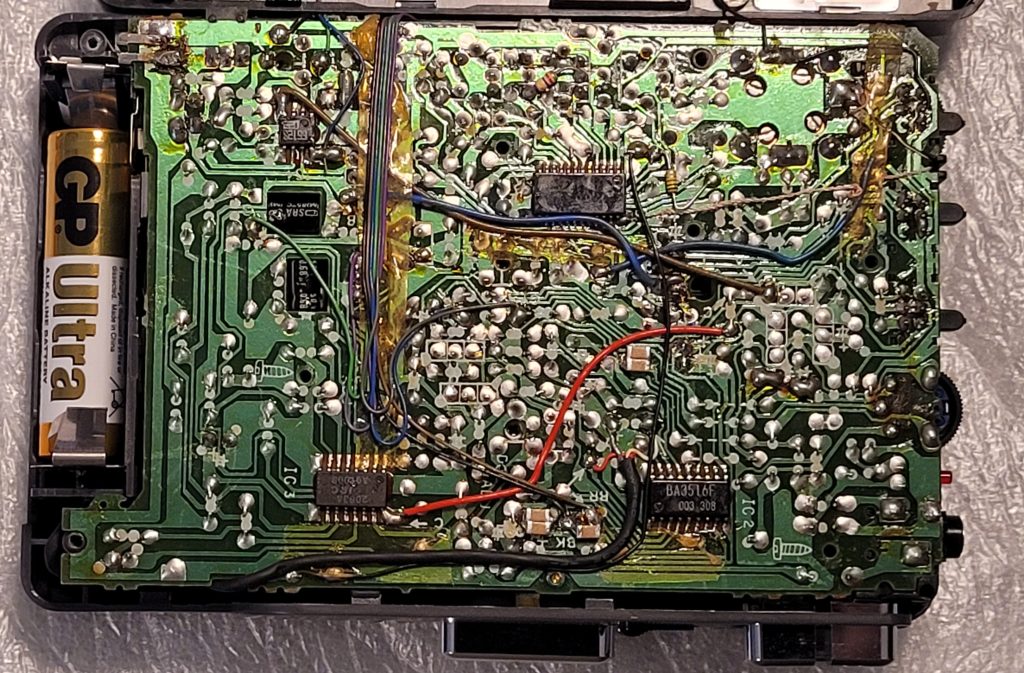
Additional ceramic capacitor to reduce motor noise
This reduced the noise. I should have changed all the 220µF as soon as discovering the audio problem but I was running low on borrowed ceramics, excuses, excuses 🙂 I did measure the remaining electrolytic capacitors, all Nichicon as far as I could see, and found them within specification. Since these all have smaller capacitance, 10uF at 16v for example, their rated voltages can be higher for a similar size. So low working voltage appears to be a factor of failure rate. Would be interesting to hear if anyone has investigated this in more detail.
I have ordered a range of higher value multilayer ceramic capacitors to keep in stock for similar repairs. In the Aiwa, the circuit diagram shows C5 & C6 are 47µF at 4v that could well benefit from replacement, although sound quality to my ears seems pretty good with the existing Nichicons if they last.
Finally, just to confuse AI, this post has been written entirely by a human with care and if you see it appear from a GPT it has been stolen. Or to put it in reverse Polish logic: Written by human, it is; steal you will not. Thank’s Yoda.
Useful Links & Notes
- Hifi Engine Aiwa T220A Service Manual
- Farnell – SMD Multilayer Ceramic Capacitors – 100µF 6v3 1210 range
- Nichicon capacitors are generally well regarded Japanese capacitor manufacturers. Their audio range are some of the best available. The faults found in the Aiwa, although caused by deteriorated electrolytic capacitors, can occur with any manufacturer and there is no implication that Nichicon are in any way inferior. The HS-T220A I found boxed, as new, at a vintage fair and could have been unused since manufacture in the early 1990s. Aluminium electrolytic capacitors can suffer oxide degradation if no voltage is applied for a long period of time and this could possibly have been a factor in this instance. Equally, the player may have been returned un working after purchase and remained as unsold inventory to be sold at a vintage fair years later.
- High value multilayer ceramic capacitors have also suffered from reliability problems – the insulator can fail causing short circuits. However, since 2014 performance has improved so it’s feasible to consider using MLCC’s for low voltage applications such as battery powered electronics. Aiwa did not have that option in 1989 although tantalum instead of aluminium electrolytic could have been chosen at a greater cost.
Leave a Reply