
Following our series highlighting user experience design failings, this post runs through a great example of a well thought through user journey. We’ll show you, and other financial organisations, that it is indeed possible to provide an effective joint account opening process without the need for paper or post.
Context
In Yorkshire Building Society Design Failings – part 2 we showed you one example of how some financial services providers ignore the digital user needs of joint account holders. Although these providers offer the latest mobile Apps and promote online access as their primary delivery channel they fail to deliver for some user types. Joint account holders are often classified as lower priority and revert to paper or physical channels resulting in lengthy delays.
User authentication is often cited as the reason for the poor joint account opening UX. The primary account holder begins the online account opening process but the introduction of a secondary account holder results in complexities and the provider’s product owner decides to digitise that part later citing Minimum Viable Product or MVP! I guess the account opening project team get so focused on delivering primary use case scenarios they never get around to implementing the alternatives.
However, joint account holders, together with an increasing aging population, are an important cohort of user types and should not be ignored. Although there may be fewer joint accounts, their average savings balances are often larger and so it makes sense for providers to consider their online needs.
Doing it right
Marcus, by Goldman Sachs, are of course a new entrant to UK consumer banking having launched here in 2018. So you may argue they don’t carry the legacy of traditional paper based processes that incumbent UK financial organisations have endured.
On their website’s About us section Marcus highlights they combine over 150 years of Goldman Sachs’ financial expertise so you may think there’s a legacy in old ways. However, Marcus also mention this is combined with the innovation of a fin-tech and that they want to “help you manage your savings easily and effectively.” As I’ll show, Marcus have indeed managed to deliver a fully online joint account opening process.
So can this simple philosophy of putting the user’s need before that of the product team’s delivery be the reason for the success? It’s easy to dismiss corporate mission statements or perhaps simply ignore them when embarking on a new agile delivery. Here at Storycase, we’ve seen several digital transformation programmes with a plethora of mission objectives and hierarchies of target operating models were it’s too easy to loose sight of the hapless users.
Driven by user needs
In a joint account opening process there are two primary users. And that’s the problem for an online delivery channel in which there’s usually only one authenticated user. How can a second user be part of the journey when they don’t have a user account and are not logged in? Let’s just revert to paper, right? No. For Marcus and other enlightened providers paper is not an option as it does not align with the corporate mission and certainly does not meet the user’s need.
Let’s look at how Marcus solves this. When you chose to apply for a joint account. You and your joint applicant will both need your own email address, because this is what you’ll use to log into your account. Both need to be present during the application as you’ll each have your own part to complete. You will be taken through the application first, then the other.
You have to successfully complete your part before they can agree to open an account for you.
Simple and effective. Of course, each applicant has to answer questions to ensure Marcus can identify the individual and pass the AML regulations that apply. And as a joint account holder, some of your personal information may be visible to the other joint account holder. But this should be reasonable as it’s a joint account!
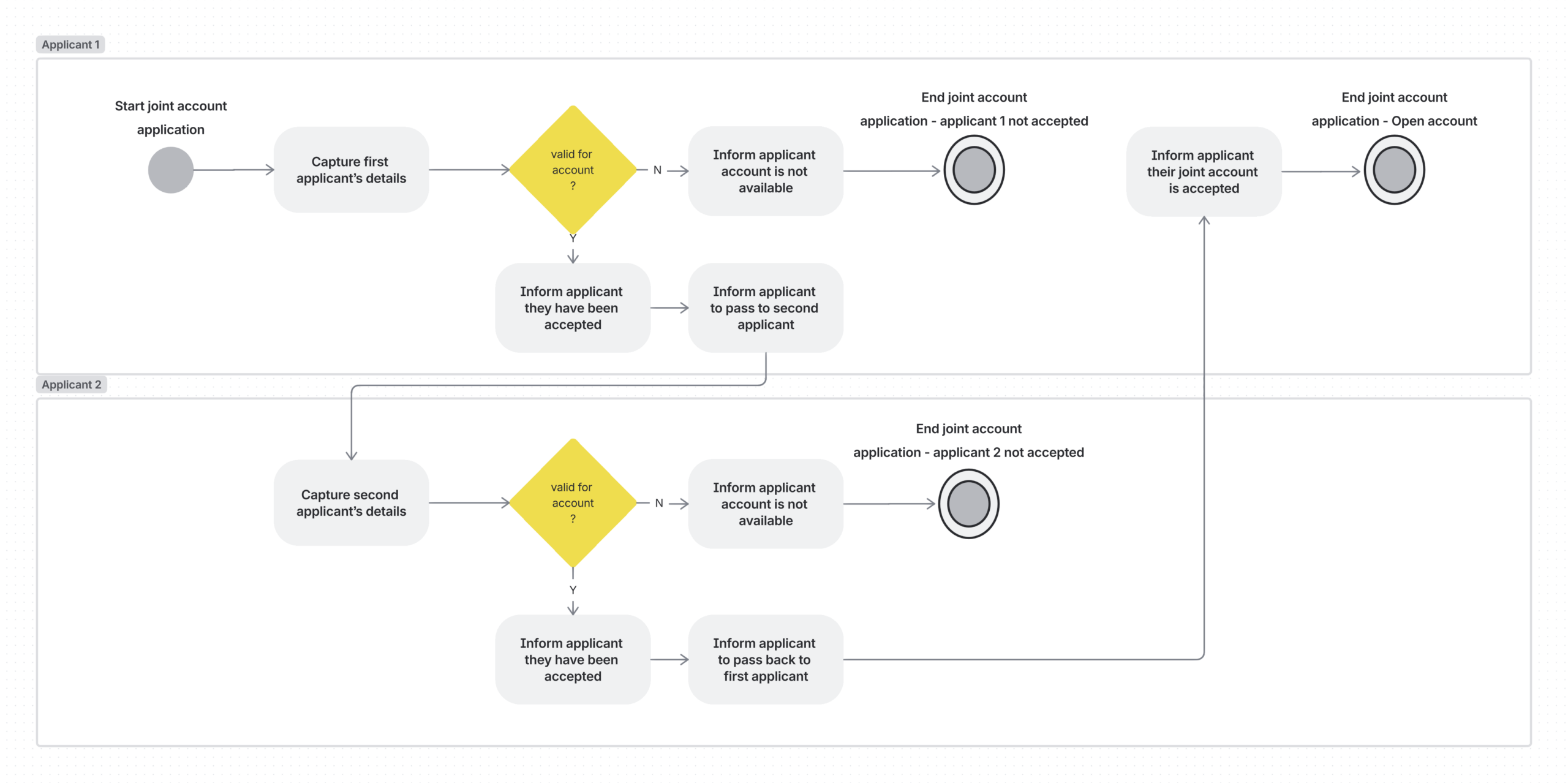
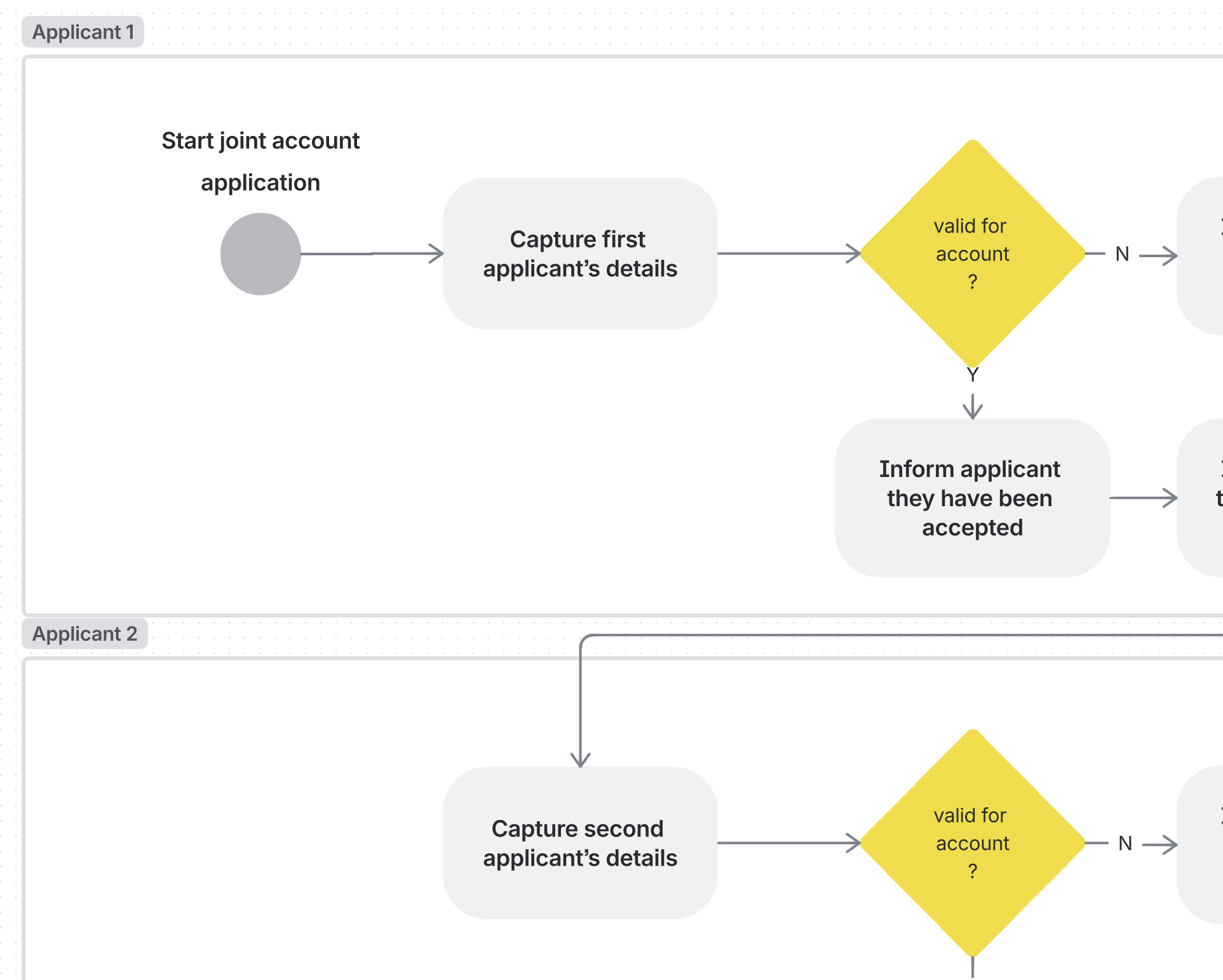
Modelling this journey with swim lanes demonstrates how the first applicant’s online session is used to pass from one applicant to another. The second applicant doesn’t need to login on their mobile or laptop, they simply pass control between each other using one device.
Once the joint account application has passed verification and email is sent to each applicant to set up their online account. This way each applicant can choose their personal security credentials. Overall a smooth user experience which enables immediate account opening for both applicants. I should point out that each applicant must pass an online verification process and this will inevitably restrict certain people with insufficient criteria.
UX design features
The design team at Marcus have also made it smoother for applicants as they step through the data entry screens. Here are some examples.
Dates

Notice the expected date format is shown in the heading along with the hint text that pre fills the date. As you enter a character the hint is overwritten and separators appear automatically. If you make a mistake and backspace the hint reappears. This makes it super easy to use and avoid mistakes.
As you expect, if you move away from an incomplete entry the data issue is highlighted:
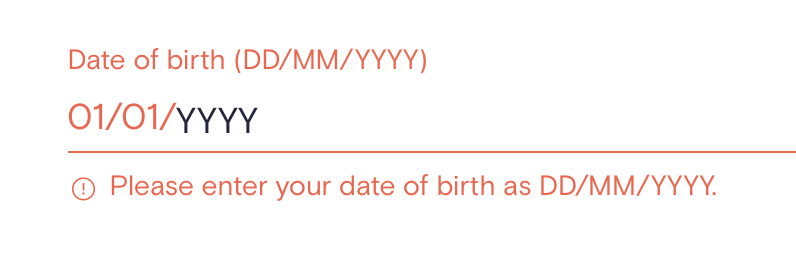
Marcus has followed an industry standard and used a red colour to draw attention to errors albeit the only data entry in error above is not actually red! Accessibility has also been considered with an exclamation icon and a textual error description for screen readers.